Why Trust in Teams Starts With Trusting Yourself
Someone told me recently they're burnt out.
When I asked more, what became clear wasn't just exhaustion. It was years. Years of eroded trust. Trust that slowly dissolved between them and the people leading them. That's what showed up as burnout.
I'm seeing this pattern. Teams that look fine. People who show up and do the work. But there's a heaviness underneath. A presence that isn't really there.
That's what happens when trust has eroded over time.
Trust Starts With You
Trust doesn't start with other people. It starts with you.
I've learned to trust my body signals, my thoughts, my gut. When something doesn't sit right, there's information in that discomfort. It's telling me something true about what I actually feel.
When I know my values clearly, I don't hesitate. I trust my gut sense because I have enough self-awareness to check in early. I can feel the difference between fear and misalignment. That's what lets me make decisions that are actually mine.
But people sense when you're not trusting yourself. That gap between what you're saying and what's actually true, that's what breaks trust down.
Trust Flows Through Systems
When I work with teams, I see this clearly: trust doesn't only live between you and your people. It flows through the whole system.
Decisions that aren't explained. Values that are stated but not practised. What's said in the meeting and what's said afterwards being two different things. Your people feel all of it.
When you know your own boundaries and values, you can name what's not aligned. You can challenge it. You can say: this doesn't sit right with me. That's what shifts a system.
But if you haven't done the work to know what feels true for you, you stay silent. And silence is a signal. It tells people that everything's fine when it's not.
What Actually Builds Trust
Trust builds when what you say and what you do are the same thing. That's only possible when you know what your values actually are. When you've checked in with yourself enough to know your boundaries. When you understand what feels true for you.
From that place, you're not managing how you come across. You're just showing up as yourself. Consistently. Even when it's inconvenient. Even when it's uncomfortable.
Key to alignment is practice, not perfection.
It's not one grand gesture. It's knowing yourself well enough to trust yourself. That's what lets you build real trust with others.
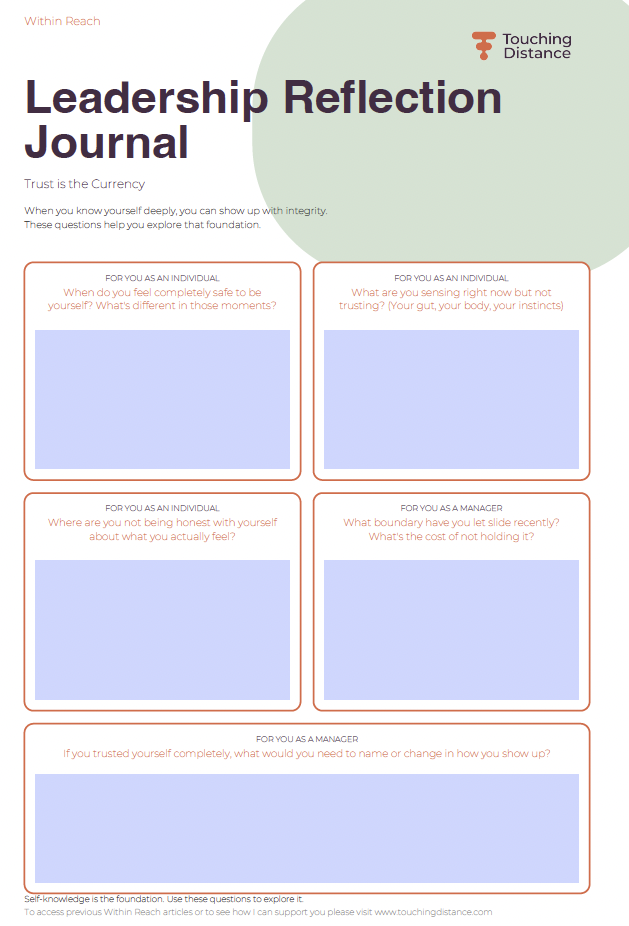
This week's leadership reflection journal
Take 20 minutes and sit with these.
Download Your Journal Page Here
When you know yourself, your boundaries, your values, what feels true for you, you stop accepting what doesn't align.
You challenge it. You name it. You show up differently.
Your team feels that. Your organisation feels that. Trust gets rebuilt.
But this work isn't something you need to figure out alone. It can feel overwhelming to have to tackle everything at once, and how often do we hang with discomfort? That's where a conversation can be the easiest step to take. Working with someone you trust can help you see what you can't see on your own.
If you're ready to build this foundation, to know yourself well enough to trust yourself and challenge what needs to change, let's talk about it.
With you,
Linda
Founder of Touching Distance
