The questions I was told to stop asking
On values, the children we were, and why the language we didn't have then matters so much now.

A friend of mine has been navigating something I suspect many parents know well: her daughter is in the middle of a difficult friendship. The kind where something just feels off, but the child doesn't have the words for what that is.
We talked for a while about it. And somewhere in that conversation she asked me a really interesting questions: What would have helped you, if you'd known then what you know now?
My answer came quickly: the language.
I was a curious child. I enjoyed being in the company of grown-ups because I could learn so much. I asked a lot of questions, perhaps too many for some classrooms, some situations, some adults around me. I remember being told, more than once, that I asked too many questions. Not unkindly, always. But clearly.
What I know now is that I wasn't asking too many questions. I was already living by values I couldn't yet name: curiosity, connection, the need to make things tangible and human before I could take them in.
Without that understanding, the message I absorbed was simpler and less true: you are too much.
I think about my friend's daughter, and the friction she's feeling in that friendship. When we're young and something feels wrong in a relationship, we reach for the explanations available to us: I don't like them. They're difficult. I'm difficult. Something is wrong with me.
But so much of that friction is actually a values collision. Two people with genuinely different ways of moving through the world. Not a problem, a difference. Except we don't give children that frame. We don't often give adults that frame either.
Knowing your values doesn't remove conflict. It doesn't make every difficult relationship suddenly make sense or become easy. But it changes what the friction means. Instead of something is wrong with me, you get to ask: what matters to me here, and is this a place where I can live that?
That is a very different question. And it is one you can ask at seven, at forty-two, or at any point in between.
I didn't have that question when I was young. I'm still learning, now, how much ground it would have given me.
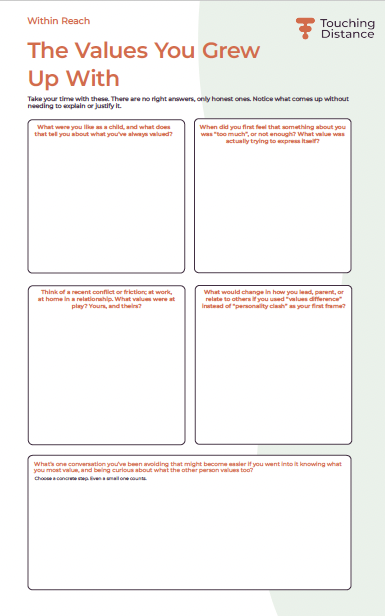
This week's reflection page is about exactly that, not just what your values are, but where they came from. When they first showed up. And what it might mean to have been living by them long before you had the words.
This week, I'm curious:
Think back to a version of yourself who was told, directly or indirectly, that something about you was too much, or not quite right. What were you actually expressing? What value was already present in you, even then?
If something comes up for you, I'd love to hear it in the comments.
Download Your Leadership Reflection Page
The child who asked too many questions, the one who cried when the group moved on before she was ready, the one who went quiet in a room that didn't know what to do with her, that child wasn't a problem. She was a person already living by a set of values in a world where she didn't yet have the language to name them.
We can give that language to children now. We can also give it to ourselves.
It's not too late. That's one of the things I know for certain.
With you,
Linda
Founder of Touching Distance
