Your Internal Boardroom
What if your emotions were not the problem?
What if fear was not something to push through, doubt was not something to silence, and anxiety was not a sign that something had gone wrong, but that all of them were trying to tell you something?
Most of us have spent years learning to manage our emotions. To keep them in check. To be professional, composed, and rational. And in doing so, we have quietly stopped listening to some of the most useful information we have.
What happened in the room
I ran this exercise recently in a workshop with a group of people navigating significant transitions, in their careers, their organisations, their sense of who they are becoming.
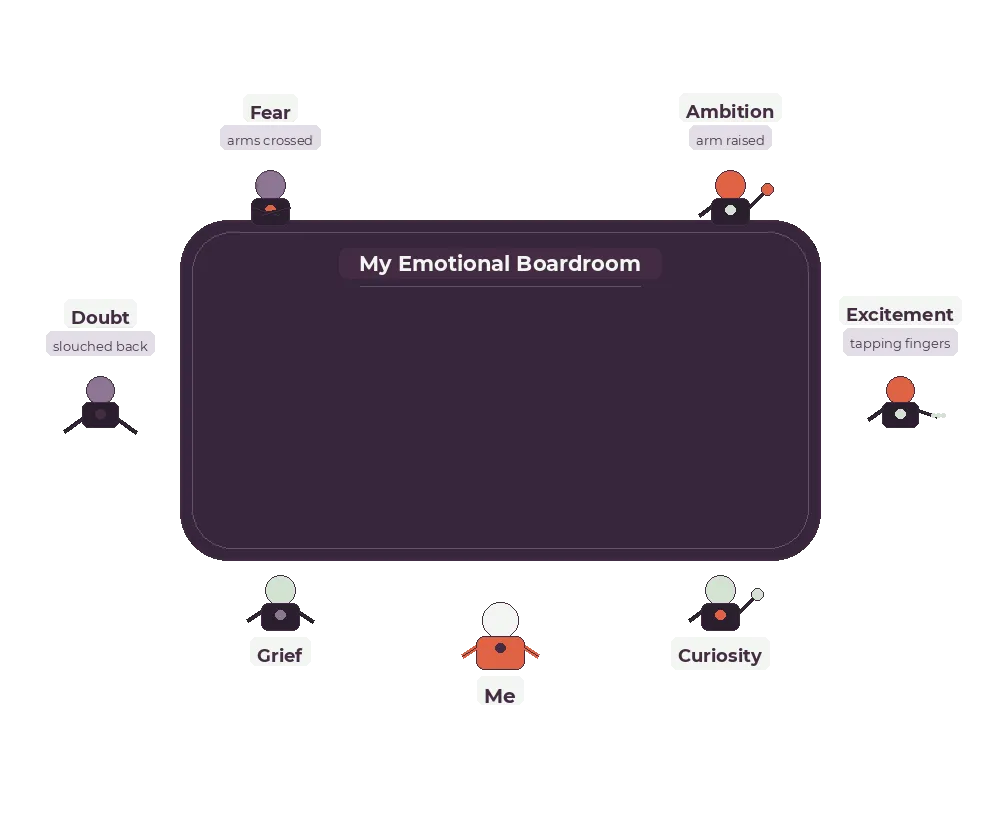
I asked them to imagine a boardroom. Their boardroom. A long table, every chair taken by one of their emotions. Then I asked them to place themselves somewhere at the table, and to notice what they saw.
What came back stopped me.
One person placed themselves at the head of the table, surrounded by grief on one side and relief on the other, and realised that what they had assumed was fear was actually something much quieter. A slight unease. Not the monster they thought was in the room.
Another found playfulness sitting almost out of reach, across the table, and recognised that under pressure, it was always the first thing they let go of. Seeing it there was a reminder that it had not gone anywhere. It was just waiting to be invited back.
Someone else was not sitting at the table at all. They were standing on it. Anxiety close. Calmness somewhere behind them, not quite in a chair. And three seats with no names yet.
That last detail, three emotions present enough to occupy a seat, but not yet named, we sat with as a group. Because most of us recognised it. The thing that is clearly there, that you can feel the weight of, but have not yet found the words for.
What this exercise does
The moment we name what we feel, specifically, not just "stressed" or "fine", something shifts. We move from being hijacked by an emotion to having a relationship with it. From reacting to responding.
Emotions are not noise. They are data. Fear might be signalling that something matters deeply to you. Doubt might be asking you to look more carefully. Anger might be pointing to a boundary that has been crossed.
The question is not how to get rid of them. It is how to let them speak, without letting any single one run the whole meeting.
Try it yourself
I have recorded a short visualisation to take you through this exercise.
Five minutes, alone, wherever you are.
Grab a piece of paper and a pen and click the link below.
If you'd rather read it, click here.
Click to listen to the visualisation exercise
Three questions to sit with
Which emotions dominate your boardroom, and which ones are you ignoring?
What is the emotion you least want to hear from? What might it be trying to tell you?
How could your boardroom work for you, rather than against you?
What I notice every time I run this
People already know. Not everything, but more than they think. The exercise doesn't give them answers, but it creates the conditions to hear what is there and very real for them.
What tends to go deeper is when someone asks a question you would not have thought to ask yourself. In that workshop, it was often the simplest ones. What does it feel like in your body? How long has that emotion had that seat? What would it mean to listen to it, just this once?
That is where things shift. Not in the exercise itself, but in what gets uncovered when someone is genuinely curious about what you find there.
If something came up for you and you want to go further with it, you know where I am. Book a session to explore together here.
What did you find at your table? Hit reply. I'm genuinely curious about what came up.
With you,
Linda
Founder of Touching Distance
